Why "service" is a loaded word in Anthropic's S-1
Anthropic's S-1 calls its AI a service for product liability purposes and admits courts may disagree. A Florida court and the EU already lean toward product. The contract decides the gap.
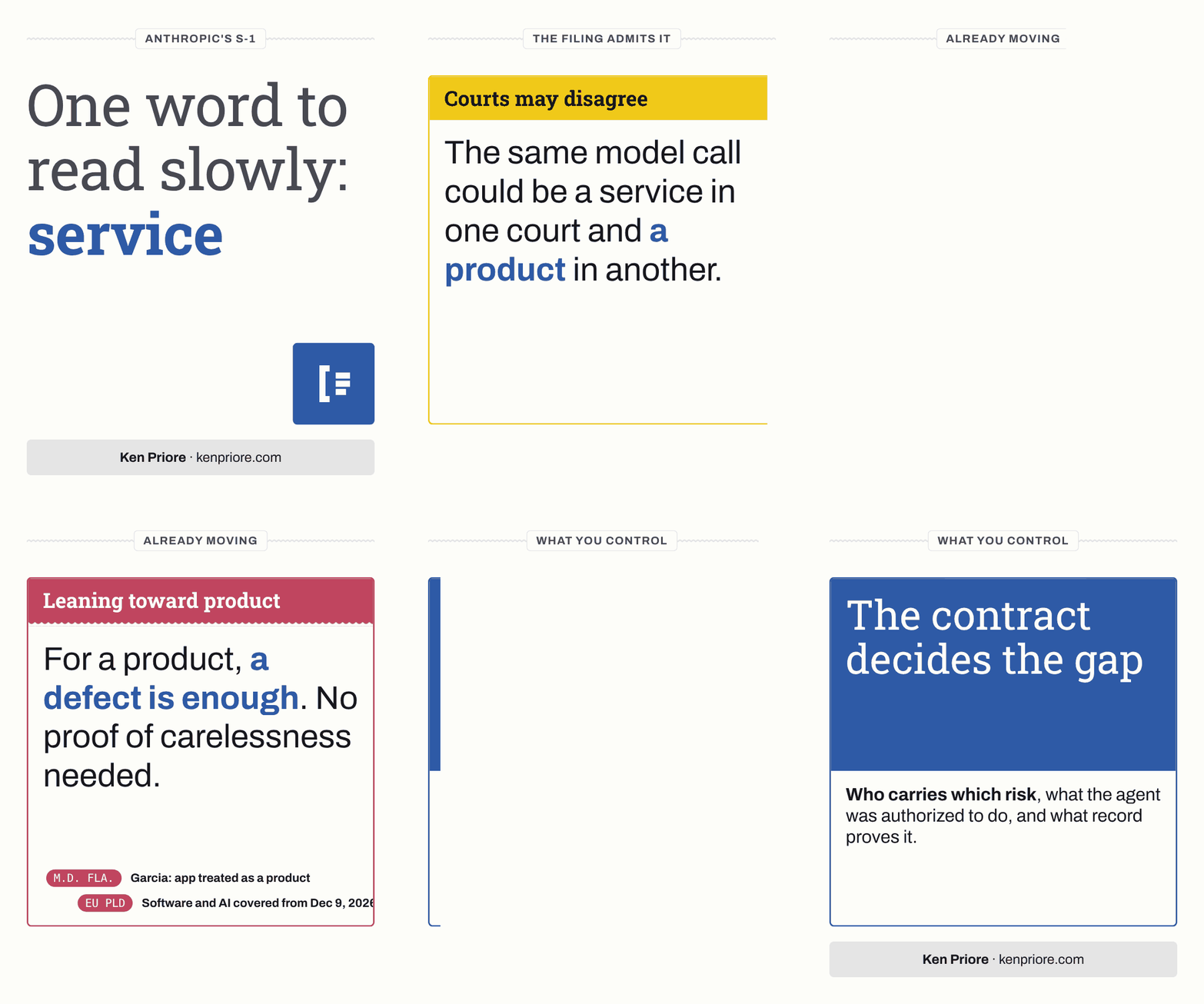
Anthropic's S-1 has a word on pages 50 and 51 that lawyers should read slowly: service.
In its risk factors Anthropic says it believes its offering is a service rather than a product for product liability purposes. In the same breath it says courts and regulators may reach different conclusions across jurisdictions. That's a company going public telling investors its liability theory might not hold. (Form S-1 on EDGAR) The companion piece on the filing walks through those pages and what the S-1 says about agent liability.
The label carries the risk because product liability is strict. A plaintiff who shows a defective product caused the harm doesn't have to prove anyone was careless. A service is usually judged on reasonable care: did the provider act the way a prudent provider would? One standard lets you defend your process. The other asks only whether the thing was defective.
For AI the line has always been blurry. A model is software you call over an API and pay for by usage. Nothing ships in a box. That looks like a service. It also produces outputs a user can't inspect before relying on them. The user had no say in the design. That looks a lot like the problem product liability was built to solve.
Courts and legislators are already leaning. A federal court in Florida tested the question in Garcia v. Character Technologies. In May 2025 the court let product liability claims against Character.AI's chatbot app go forward at the pleading stage. It acknowledged the app may have some aspects of a service and still treated it as a product. That holding covers claims about defects in the app. It leaves aside the ideas and expression in what the chatbot says. The defendants and Google agreed to settle in January 2026. There's no appellate ruling. It still tells plaintiffs' lawyers the argument survives a motion to dismiss.
The EU went further by statute. The revised Product Liability Directive, (EU) 2024/2853, brings AI and other software into scope and imposes liability for defective products regardless of fault. Exposure extends past the point of sale to failures to provide security updates. Courts may presume defect or causation where technical complexity makes proof excessively difficult for the claimant. Member states have until December 9, 2026 to write it into national law. As of August Croatia, Hungary and Lithuania had adopted laws. Several others had published bills, including Germany and the Netherlands. (Covington, Inside Privacy)
Put those together and the same model call could be a service in one courtroom and a product in another. Anthropic's filing says as much.
When the law won't say which regime applies the contract does the work. That holds for the model provider and even more for the company deploying agents on top of it. The S-1 itself doubts whether its limitation-of-liability and indemnity terms will hold against claims from agent conduct, as the companion piece covers.
Read your own AI agreements with the same attention. Start with how the vendor describes what it provides. If the contract calls it a service, check whether the warranty disclaimers and caps assume a negligence world that a court in Florida or a member state in the EU may not recognize. Work out who carries the risk of a defective output and who carries the risk of a misused one. Then look at what the agent was authorized to do and whether anything records that authorization in a form you could put in front of a judge.
That last piece matters more under the EU presumptions. A party that can't explain how its system behaved starts the case behind.
The classification fight is an accountability fight. The label decides whether the injured party has to prove fault or only a defect. The records decide how that fight goes. Anthropic wrote "service" knowing it might not stick. Draft your contracts on the same assumption.