Legal2040: a third-horizon story I wrote for my executive team
Legal2040 is a story from 2040 about what happened to American law. I wrote it as a working tool for my executive team. Why fiction works for strategy, and the eight conditions that would all have to come true.
On a Tuesday in October 2040 a florist named Rosa Delgado settles a dispute with her flower wholesaler in four minutes. She disputes a charge on her phone. A system pulls the contract and the messages, applies the rule and returns the money. She finishes stripping thorns for a funeral order before she reads the decision. Her father once won a lawsuit and lost his restaurant paying for it.
That's the opening of Legal2040, a piece of fiction I wrote in June. It's written as if it ran in The New Yorker in 2040 and looks back on fourteen years of change in American law.
I wrote it as a working tool. I brought it into a meeting with my executive team at Docusign. Strategy documents about the future of legal tend to stay abstract. Abstract futures are easy to nod along to. A story is harder to wave off. When a hardship judge sets a $61,000 medical debt at eleven dollars a month, someone in the room objects to the default that kept collection running while the man waited for his hearing. When a general counsel closes her transactional group and her finance team's spreadsheet makes the call feel automatic, someone asks whether it was really the spreadsheet's decision. People pick a character and argue. The argument was the point.
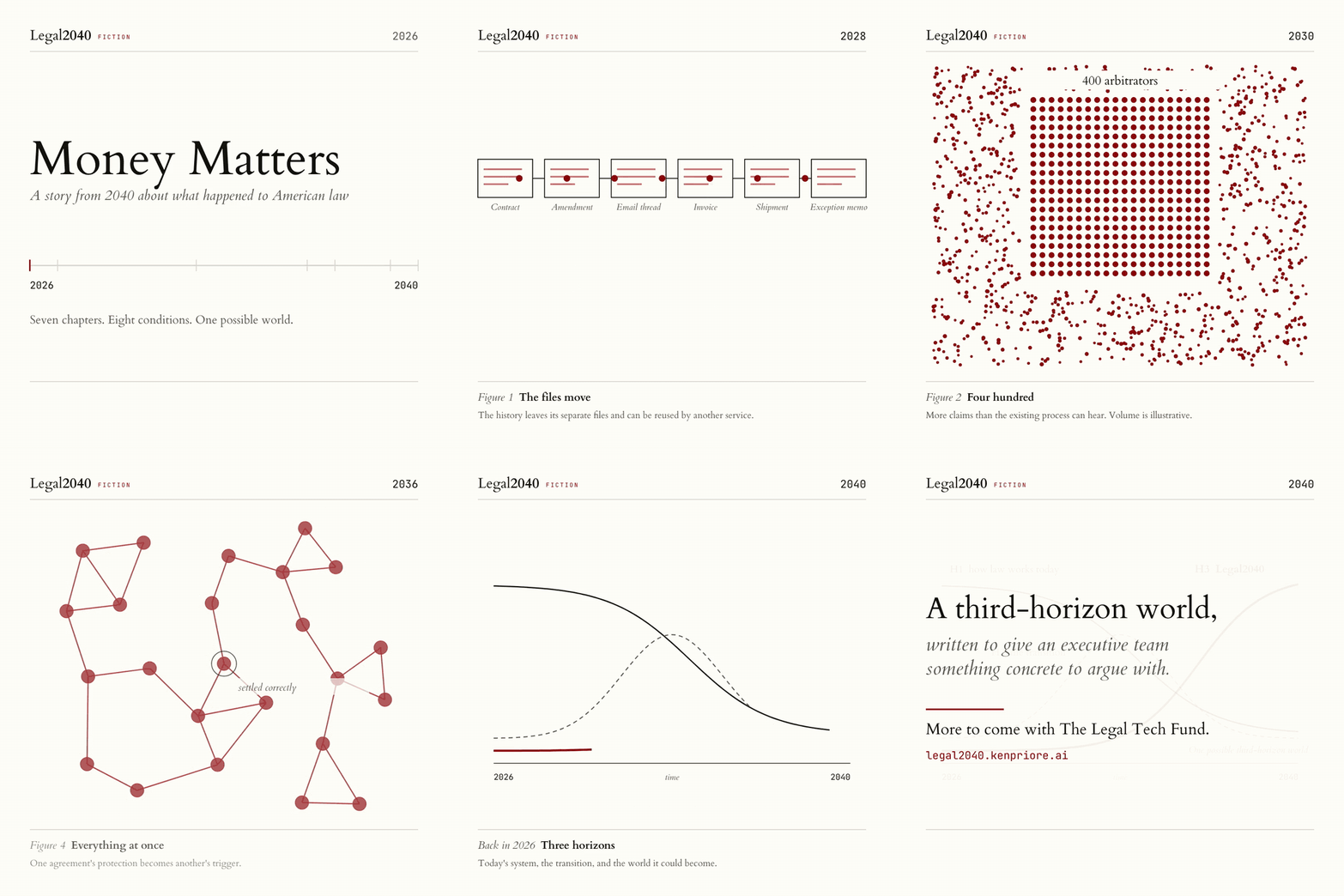
The story moves through seven chapters. Companies take control of their legal records. They write exports and stable identifiers into their outside counsel renewals so a different supplier can act on that history. An arbitration body automates small commercial disputes and vacates eleven hundred awards in its first eighteen months over a time zone bug. Maryland recognizes defined categories of automated decisions, and Delaware follows. A legal department closes on a Thursday in March 2033. A stablecoin that met every rule written after TerraUSD and USDC loses its peg. Contracts reprice themselves four times before lunch. A protection in one agreement becomes a trigger in another. The rebuilding concentrates power in whoever runs the network. And a county court in Tolliver, Montana keeps one open hearing every third Tuesday.
In three horizons terms Legal2040 is a third-horizon world. It's far enough out that the way law works today has mostly given way. It's specific enough to test. It's one possible world. It isn't the work I did this spring with The Legal Tech Fund. That project is bigger, more rigorous, and maps more than one future. Legal2040 grew alongside it and borrowed the frame. More on the Legal Tech Fund work soon.
The part I'd hand any general counsel is the afterword. For this world to arrive eight things would all have to come true. Records have to be usable and able to move. Systems have to get the structure right: the right contract, the right party, the right event. Decisions have to be verifiable. A correction has to reach every system that acted on the error. Courts, agencies, insurers and contracting parties have to authorize consequential use. Accountability has to land on someone with the information, time and power to act. The economics have to pay for the safeguards along with the service. Institutions have to keep training and paying for the expertise that remains. And the timetable probably needs a shock.
Only two of these are mostly about the technology. The rest are decisions someone is making now: a procurement clause, a default setting, a court rule, a budget line. Product counsel and legal leaders have more say over those than they tend to assume.
Read the story and tell me which condition you think fails first.