Who Pays When an AI Agent Gets It Wrong? Anthropic’s S-1 Says the Law Hasn’t Decided
Anthropic believes its offering is a service rather than a product under product liability law, and it says courts and regulators may reach different conclusions across jurisdictions.
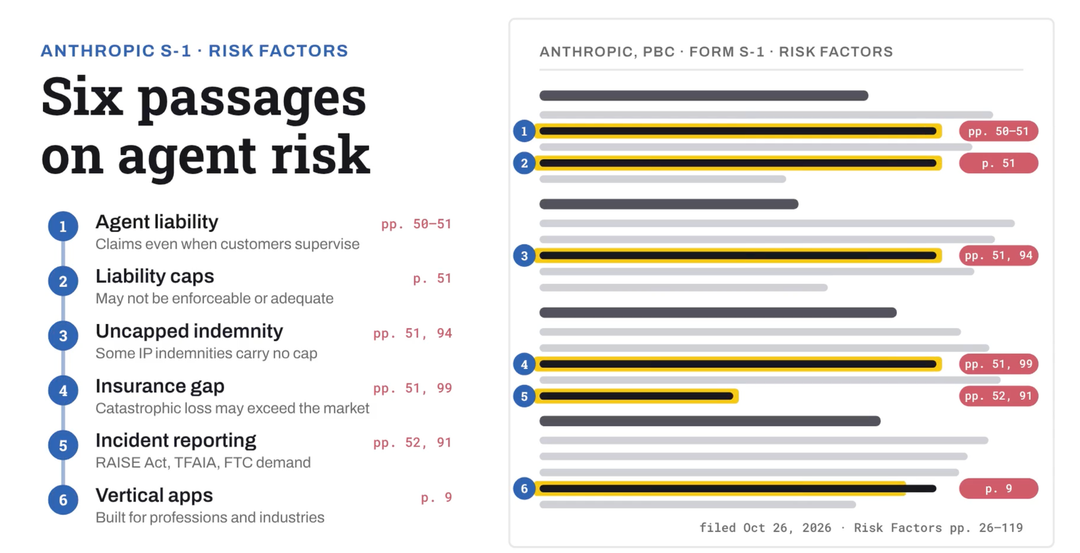
Somewhere right now, an AI agent is moving money, onboarding a vendor, or deleting files it was told to clean up. If it gets one of those wrong, someone will ask who pays. Anthropic’s IPO filing, made public on Monday takes on that question.
The headlines went to the numbers: $16.3 billion in revenue for the first half of the year and an $80.7 billion net loss. The risk factors got less attention. They run 94 pages, from page 26 to page 119, and on pages 50 and 51 Anthropic lays out how unsettled the law of AI agents still is. This is a readout of what the filing says, with page numbers so you can check each point against the source.
The core passage sits on pages 50 and 51. Anthropic says the legal frameworks governing liability for actions taken autonomously by AI systems, including its own agentic products, are unsettled and could expose it to significant and unpredictable claims. It says the doctrines that would apply, agency, product liability, and professional negligence, were developed around human decision-making and have not been authoritatively applied to autonomous AI systems.
Three open questions follow. Anthropic believes its offering is a service rather than a product under product liability law, and it says courts and regulators may reach different conclusions across jurisdictions. It says it is unclear whether and when an agent's actions create binding legal obligations for the user or enterprise that deployed it. And it says it is unclear whether its own contractual protections, including limitation-of-liability and indemnification provisions, will be enforceable or adequate against claims arising from agent conduct.
The filing adds that it may face claims from customers, their end users, or third parties over harm caused by its agents' autonomous actions, even where the customer configured, deployed, or supervised the agent (p. 51). It says the absence of settled legal standards makes both its exposure and the adequacy of its mitigation measures uncertain. It relies on warranty disclaimers and limitation-of-liability terms, warns they may not be upheld, and notes that in some cases it has contractually assumed additional liability.
Indemnity appears in two places. Certain agreements with external evaluators and testing vendors require Anthropic to defend and indemnify the evaluator against some third-party claims with no cap on its liability (p. 51). Separately, it says its IP indemnities may be excluded from the limitation-of-liability provisions in its contracts, and that certain agreements require it to defend and indemnify the counterparty against IP infringement claims with no cap (p. 94).
On insurance, Anthropic says that for a catastrophic AI-related incident, no single insurer, and potentially the industry as a whole, may have the capacity or expertise to underwrite coverage that matches the exposure (p. 51). It describes the market for AI-specific coverage as nascent and evolving, and warns it may be unable to obtain coverage for some AI liabilities on commercially reasonable terms, or at all. It points to the Bartz copyright settlement, a $1.5 billion charge in 2025, as an example of a claim insurance may not fully cover (p. 99).
The regulatory disclosures name specific laws. New York's RAISE Act and California's Transparency in Frontier Artificial Intelligence Act require frontier developers to report safety incidents, and Anthropic says they create heightened compliance and liability exposure for delayed, incomplete, or inaccurate disclosures (p. 91). It also discloses that in October 2026 the FTC issued it a civil investigative demand covering its consumer protection, data protection, and privacy practices and the safety and security of its products (p. 52).
Several risk factors bear on companies building on Claude. Anthropic says it has discovered errors and defects, including hallucinations, only after deployment (p. 90). It says changes to usage limits, rate limits, and model capabilities have drawn claims that its disclosures about model access or capabilities were inadequate or misleading (p. 30).
One passage outside the risk factors rounds out the picture. In the business overview, Anthropic says it is extending Claude Cowork with applications purpose-built for specific professions and industry verticals (p. 9).
Taken together, the filing leaves three questions open: whether its offering is a product or a service, when an agent’s act binds the party that deployed it, and whether its caps and indemnities will hold. It pairs them with a warning that claims may come even where the customer supervised the agent. Anthropic does not answer any of it, and on the product question it says courts and regulators in different jurisdictions may reach different conclusions.
 Anthropic