Where agent risk could go, according to Anthropic's S-1
When an AI agent causes a loss, Anthropic's S-1 calls each place it could land uncertain: insurance, contract caps and the law. One hypothetical loss, followed all the way down.
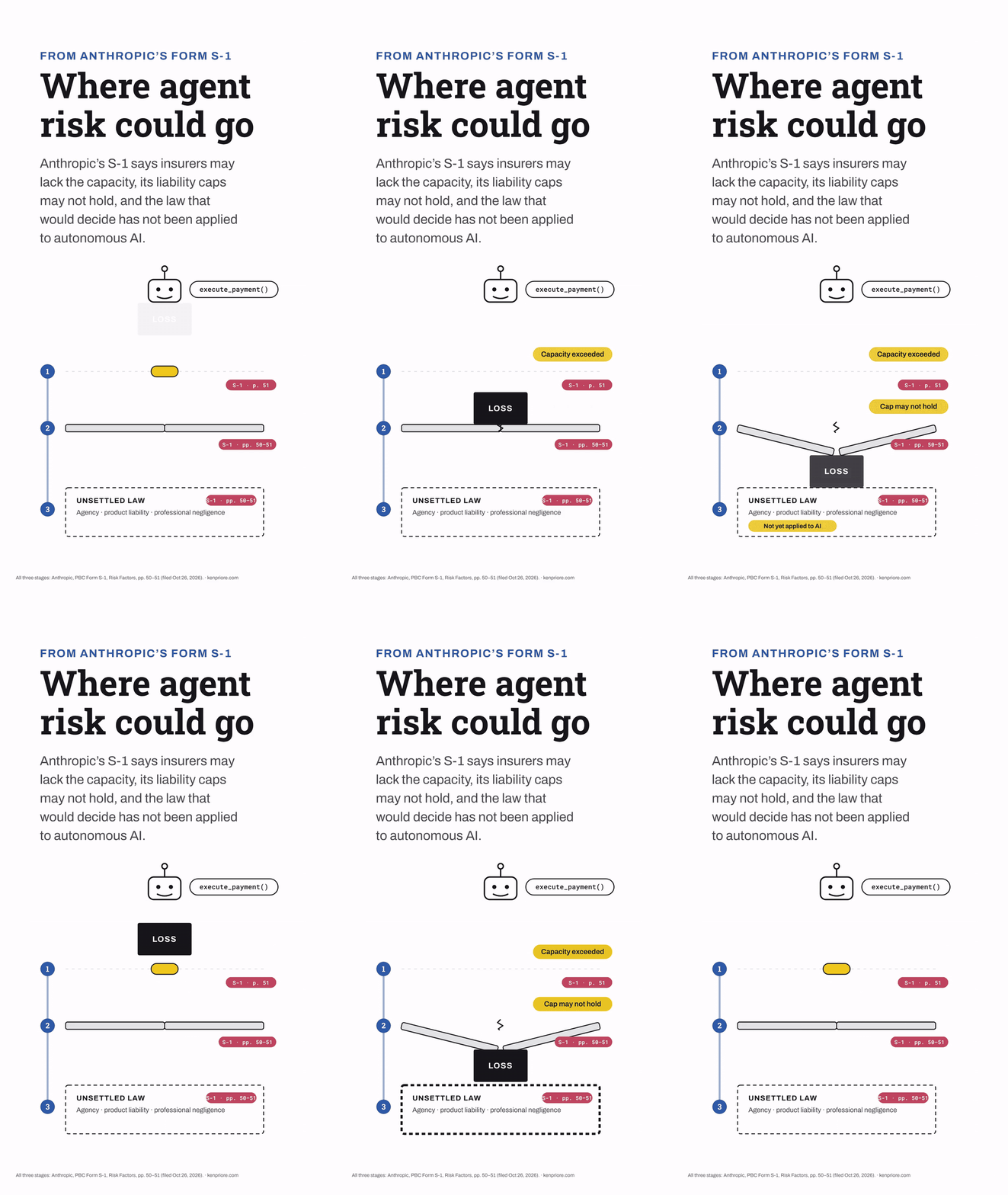
When an AI agent causes a loss, the money has to land somewhere. Anthropic's S-1, filed October 26, checks the three usual places and calls each one uncertain: insurance, contract caps and settled law. The animation with this post follows a single loss down through all three.
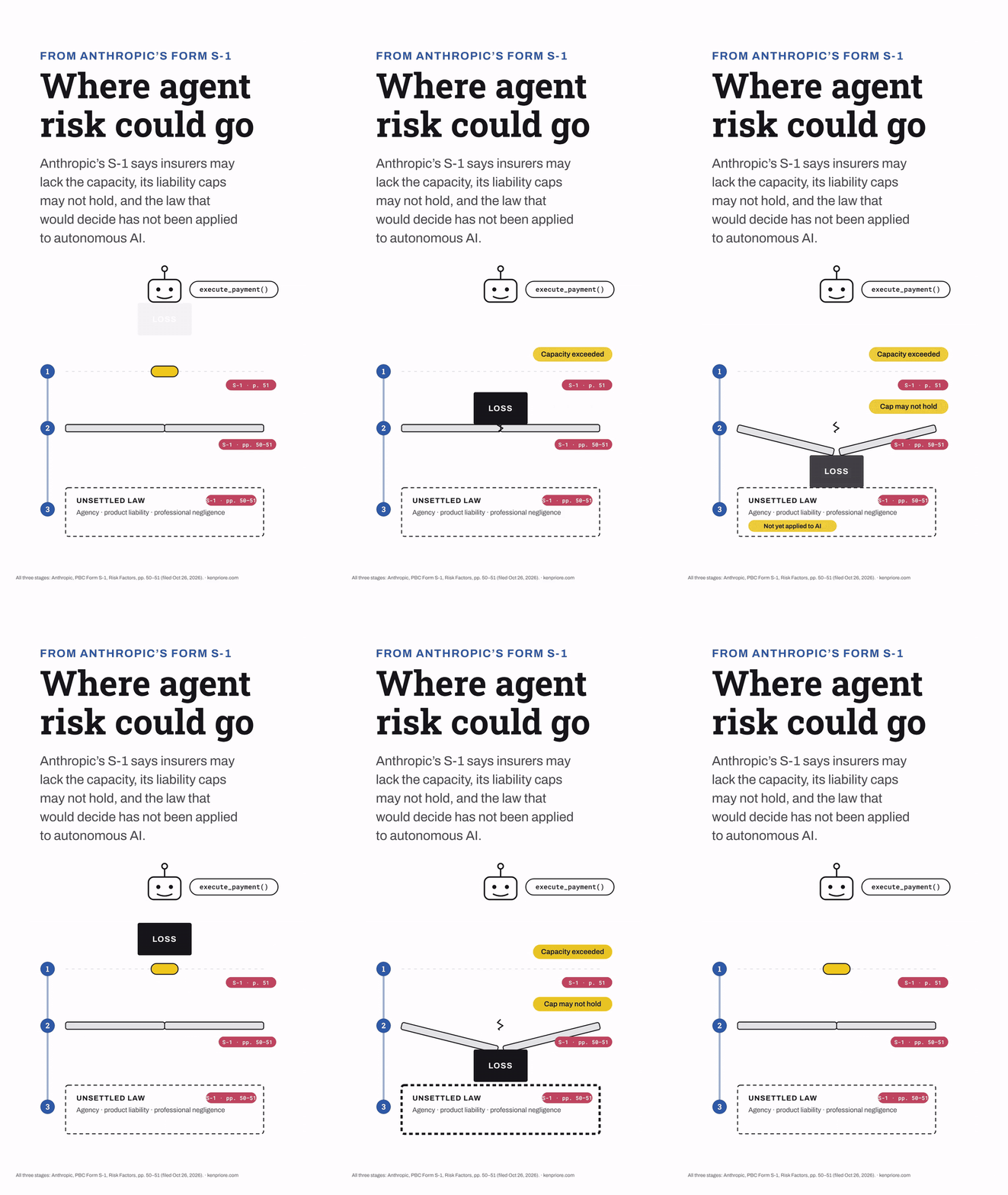
Say Marlow Residential, a property manager with a few thousand units, runs an agent that handles lease renewals. A tenant asks to renew. The agent misreads a note in the file, treats the request as notice to vacate, books a move-out inspection and lists the unit. By the time anyone notices the unit has a signed lease with someone else. The original tenant has a claim.
Marlow's first call is to its insurer. The filing doesn't speak to Marlow's policy. It speaks to the market. Anthropic says no single insurer and possibly not the industry as a whole may have the capacity or expertise to cover a catastrophic AI-related incident (p. 51). It calls the market for AI-specific coverage nascent and warns that some AI liabilities may not be insurable on commercially reasonable terms or at all. Marlow's loss is small. My guess is that the gap shows up for small claims as exclusions and narrow definitions well before it shows up as a capacity problem. The filing doesn't say that.
If the policy doesn't pay Marlow looks at its contracts with the agent vendor and through it the model provider. Anthropic says it's unclear whether its limitation-of-liability and indemnification provisions will be enforceable or adequate against claims arising from agent conduct (pp. 50–51). That cuts both ways for a customer. A cap Marlow agreed to may not protect the vendor, which helps Marlow. An indemnity Marlow negotiated may not pay, which doesn't.
Then comes the law. The filing says agency, product liability and professional negligence were developed around human decision-making and have not been authoritatively applied to autonomous AI systems (pp. 50–51). Each doctrine would send Marlow's loss somewhere different. Agency asks whether the renewal agent acted within the authority Marlow gave it. That tends to keep the lease on Marlow's side of the table. Product liability asks whether the agent was a defective product. Anthropic says it believes it provides a service. It expects courts and regulators in different jurisdictions may not all agree. Professional negligence asks whose standard of care applies. No court has said what standard a leasing agent made of software is held to.
The filing stops there. It tells investors the answers will come from courts and regulators over time.
Marlow can test each layer now while nothing is in dispute. Its general counsel can ask the broker in writing whether claims arising from an AI agent's actions are covered under the current policy. The vendor contract will show whether agent conduct sits inside the liability cap or outside it. Someone should also write down what authority the renewal agent actually has. If agency law ends up governing that document is the first thing anyone will ask for.