Nobody knows where agent liability lands, so write it down yourself
Anthropic's IPO filing admits nobody knows where agent liability lands, and the EU AI Act wasn't built for agents. Until the law settles, provider contracts, customer terms and product records decide it.
Anthropic told investors it doesn't know where the liability lands when one of its agents acts. That's in the risk factors of its IPO filing. This is the company building some of the most capable agents on the market. I pointed people to those pages on LinkedIn recently. Every in-house lawyer deploying agents should read them.
According to Free Press Journal's summary, the risk factors warn that customers and users may bring claims over the conduct of agents, that the legal framework remains uncertain, and that the liability caps in Anthropic's own contracts may not be enforceable or adequate against agent-caused claims. The filing also leaves open whether an agent's action counts as a product or a service and when an agent's action binds the company that deployed it.
I read that as candor. A risk factor is drafted to limit exposure. The drafters still couldn't name an answer. The law hasn't settled one.
The regulatory side says the same thing. In "Regulating AI Agents," Kathrin Gardhouse, Amin Oueslati and Noam Kolt treat the EU AI Act as the most pressing test case and argue that a regulatory framework designed for conventional AI systems "can be ill-suited to AI agents." The Institute for Law & AI highlighted the paper on exactly that point: the Act applies to agents in principle, and whether it works for them in practice is an open question.
The mismatch is structural. The Act sorts AI systems by risk category. An agent takes a sequence of actions, often across tools and companies, and the risk lives in the sequence. Classifying the model tells you little about what the agent did on Tuesday. The authors' conclusion is blunt: "policymakers in the EU and beyond will need to change course, and soon."
US regulators haven't settled it either. The same Free Press Journal report notes that FTC Chairman Andrew Ferguson has rejected the idea of agents that "break loose" and said liability falls on the developers or users who instruct them. That's one regulator's view. It points where this analysis points: at the people and companies around the agent.
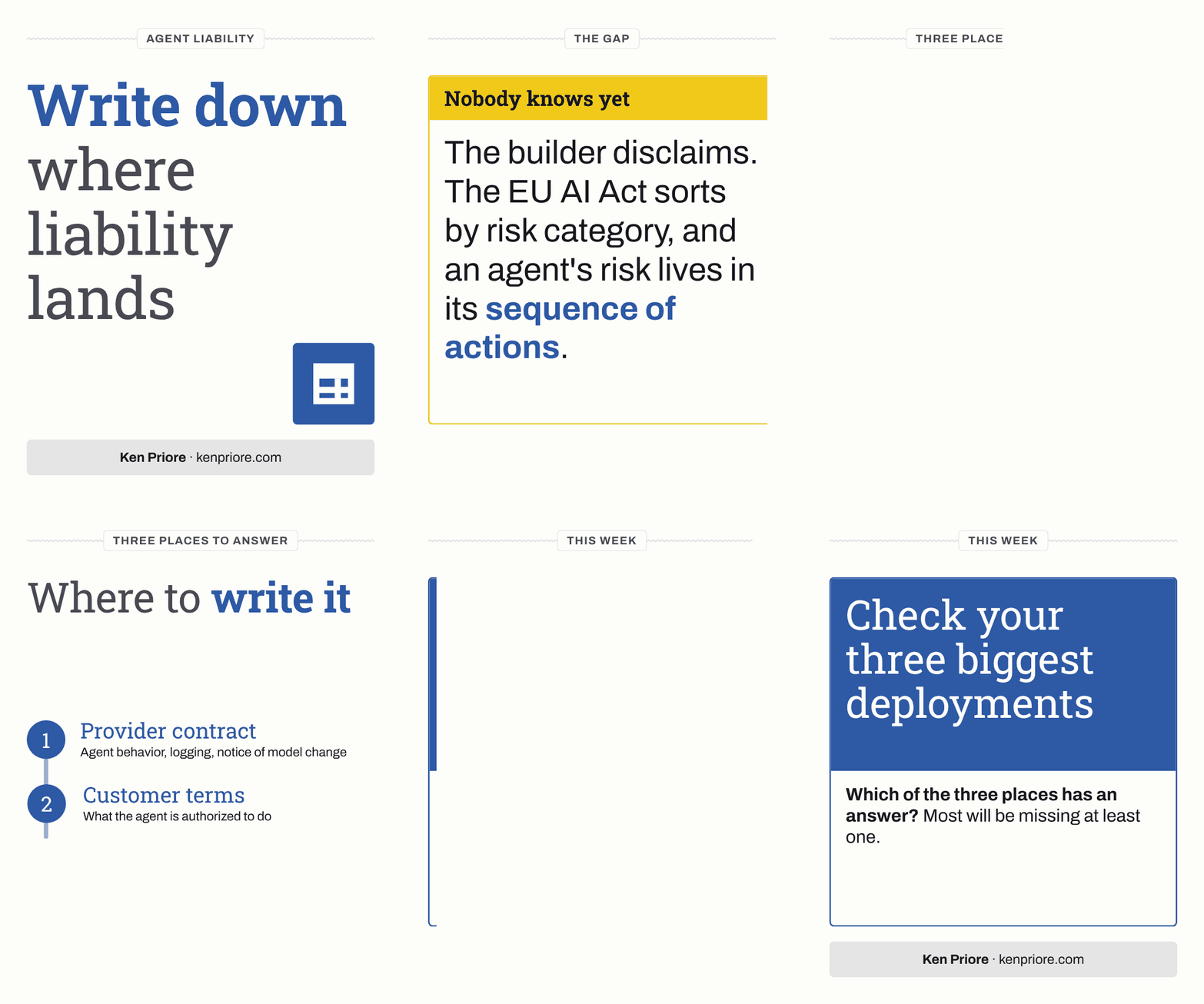
The builder disclaims, and the main regulation is still working out how to apply. In that gap, liability for agent actions will be allocated by the contracts and system design in-house teams put in place now. Teams that wait for the law will inherit whatever default the first dispute produces.
I'm not aware of a court that has settled how responsibility splits among a model provider, the platform an agent runs on, and the company that deployed it. So treat this as a prediction. Disputes will find the party the injured customer has a relationship with. For most agent deployments, that's the deployer.
The provider contract is where the deployer has the most leverage. It's available before launch. It should say what the vendor commits to about agent behavior, logging, and notice before the model changes underneath you. Anthropic's disclosure about its own caps is a useful signal here. If the provider isn't sure its caps will hold the deployer shouldn't assume the provider's indemnity covers much either.
Customer terms carry the other half. They define what the agent is authorized to do on the customer's behalf and what happens when it goes past that. Authority is the concept agency law reaches for. A customer contract that never defines the agent's authority leaves a court to infer it.
The product holds the rest: authority limits built into the system, and a record that ties each action to whoever authorized it. Contracts allocate liability among the companies that signed them. The record decides who can prove what happened.
Contracts can't solve this alone. When an agent harms a third party who signed nothing, the allocation between provider and deployer doesn't bind them, and courts and regulators will impose their own answer. That's right, and I concede it. Contracts don't stop a third-party claim. They decide who bears it among the companies once a claim lands. The design obligations they carry make it less likely that one lands at all. The record also shapes how a court sees the facts when it finally does rule.
Read the filing pages. Then pull your three most important agent deployments. Check whether the provider contract, the customer terms and the product each have an answer. Expect to find gaps. That's the work. It costs less now than after the first dispute writes the default for you.