Delaware just made the log the officer
Delaware's proposed AI-run company keeps the owner's liability shield only if the company is capitalized and its activities logged. That makes the log the officer of record. The record standard is the biggest blank in the draft.
On October 26, House Oversight Chairman James Comer sent Delaware's governor a letter asking for documents on a state plan he says could shield AI companies and their investors "from responsibility for reckless harmful actions." He wants answers by November 9. He also floated using the inquiry to inform federal limits on state AI regulation. Ars Technica has the details.
The plan is the Artificial Intelligence Company, or AIC: a Delaware entity whose day-to-day affairs are managed by an AI agent instead of a person. A single member is responsible for keeping it adequately capitalized. The member can be a person or an entity. The AIC can sue and be sued in its own name, hold property and take on obligations at the agent's direction. It operates only inside a regulatory sandbox that sunsets after 30 months. Admission runs through a committee that includes the Secretary of State, the Attorney General, the Chief Justice of the Delaware Supreme Court, the chair of the state's AI Commission, and outside attorneys and technologists. Counterparties must be told they are dealing with an authorized test entity the state does not endorse, when the test ends, and how to complain. Banking is excluded. The bill hasn't been introduced yet. Lawmakers return in January.
The framework comes out of a public-private partnership led by Norm Ai. Its CEO, John Nay, laid out the design in Fortune in July alongside Delaware Secretary of State Charuni Patibanda-Sanchez.
Comer's question is the obvious one: who is accountable when nobody is in charge? UC Berkeley's Andrew Baker told the Financial Times the likely outcome is "an overly generous liability shield." Read the draft closely and Delaware has already answered it. The answer is the record.
Corporate law anchors accountability in people. Delaware's own corporation code requires every director to be a natural person. Fiduciary duty, the business judgment rule and Caremark oversight all assume someone who can be deposed, who has a reputation, and who fears consequences.
The AIC swaps that anchor out. The member is shielded from the AIC's debts except where it fails to capitalize the company or uses it to commit fraud or a willful violation of law. The AIC must keep a log of its activities. According to Daybreak Wire's section-by-section read of the June 2 draft, the AI manager must "document any action the manager takes in a signed record." The draft also presumes the agent knows what it possesses or can derive from its structure and training, and intends the consequences an ordinarily prudent person would foresee.
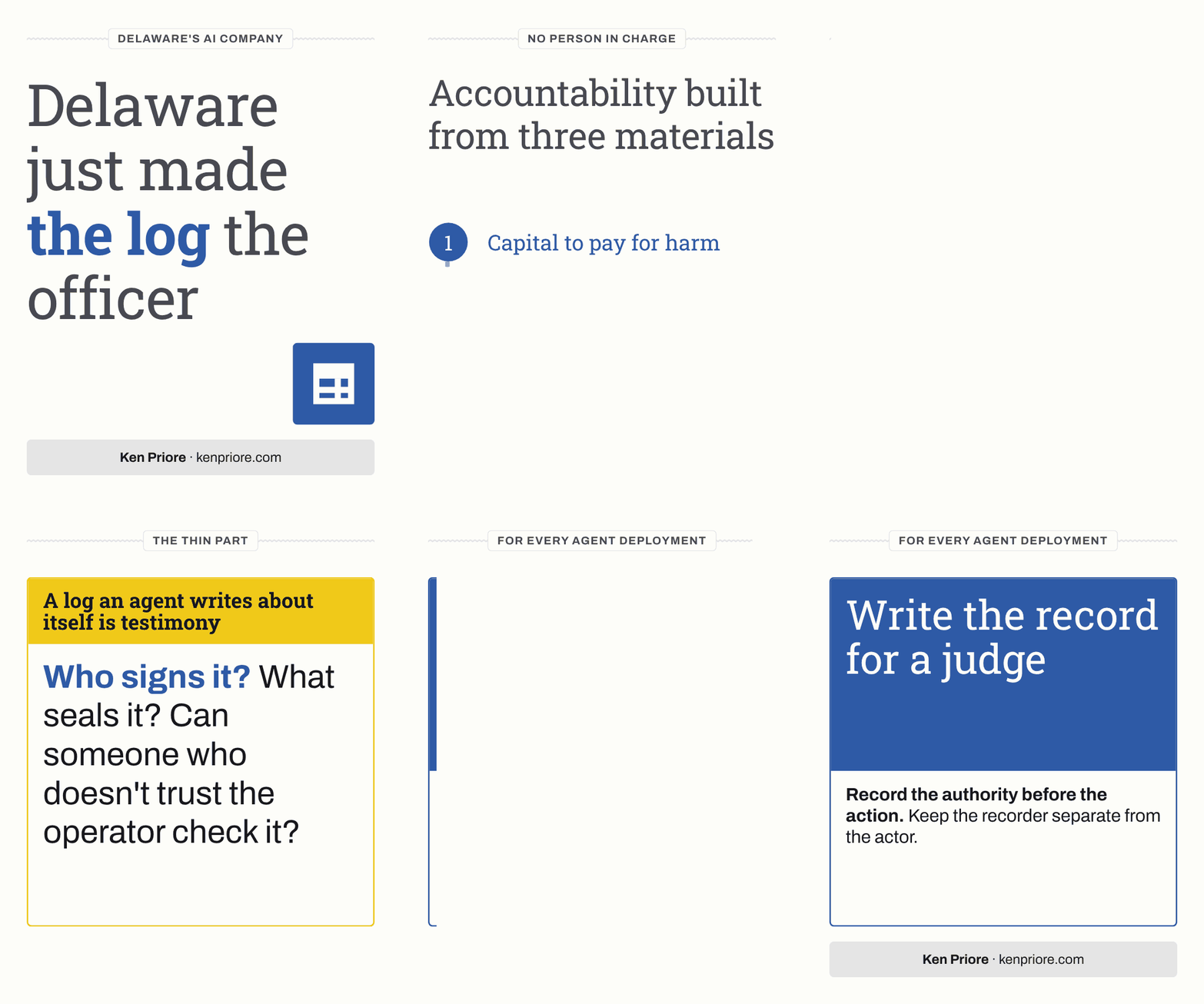
You can't depose an agent or appeal to its conscience. So the draft builds accountability from three materials: capital to pay for harm, a termination power to stop the agent, and a record to reconstruct what happened. The FT summarizes it plainly. Owners keep the shield if the AIC is adequately capitalized and its activities logged. Every later fight gets argued from that record. That covers everything from a creditor claim to a Chancery dissolution petition.
The AI manager draws the headlines but the log does the work. Delaware has made it the officer of record.
A log an agent writes about itself is testimony. Evidence takes more.
Consider what a court needs when an AIC breaches a contract or harms a consumer. Was the action inside the authority the member granted? What did the agent know when it acted? Was the record changed afterward? Who reviewed it, and when? The knowledge and intent presumptions raise the stakes. The dispute will turn on what the agent "could derive." That argument only works from a record that captures the inputs, the authority and the action together.
"Signed record" sounds solid until you ask who signs. The agent? The member? A system outside the agent's control? When the system that acts also writes the log and holds the key the signature proves only that the log came from that system. It says nothing about whether the log is complete or true.
An agent's internal trace is useful for debugging. It carries little weight in a courtroom or a counterparty's file. What carries weight is a record bound to the authorization granted before the action, sealed by something independent of the actor, and checkable by a third party who has no reason to trust the operator. Without those properties, the AIC log is a diary.
The capital floor is still blank too. Critics are right to press on it. The record standard is the bigger gap. Capital tells you how much harm can be paid for. The record tells you whether anyone can prove the harm happened, and why.
It's easy to read this as a Delaware experiment for a handful of startups. That reading is too narrow.
Any company deploying agents already runs a small version of this. The agent acts. Eventually someone asks whether it was allowed to. The answer depends on what was recorded at the moment of action. Whatever you reconstruct later is worth much less. Delaware is making that explicit and tying the liability shield to it. Insurers, auditors and counterparties will ask the same question of agents running inside ordinary companies.
Product and legal teams can act on this now. Treat the authorization grant as a document. Before an agent acts with real consequence the scope of what it may do should exist as a record that a prompt can't overwrite. Keep the recorder separate from the actor. Independence is what turns a log into evidence. Write the record for the person most likely to read it in a dispute: a judge, a regulator or opposing counsel. Engineers will still get what they need for debugging. The reverse rarely holds.
This proposal is easy to mock. The accountability critique is serious. So is Norm Ai's commercial stake in how it turns out. Norm Ai leads the partnership.
The proponents' core point still holds. Agents are already transacting. Nay and Patibanda-Sanchez wrote that "the answer is to wrap AI in legal form," and that giving an autonomous system a recognizable legal identity makes it "legible to law." Prohibition won't stop the activity. It will move it somewhere courts can't see. A federal fight over state AI authority doesn't change what any of these companies will need to prove. A supervised structure with capital, a termination power, disclosure and a record beats pretending agents aren't already doing business.
Whether an AI can run a company is the headline question. The sandbox will answer a narrower one: whether the record can carry the weight Delaware is about to put on it. That's a design problem. Legal belongs in the room where it gets solved.