What Anthropic's S-1 says about agent liability
Six passages from Anthropic's S-1 on agent liability, read against one hypothetical deployment: supervision, caps, uncapped indemnities, insurance, incident reporting and apps for professions.
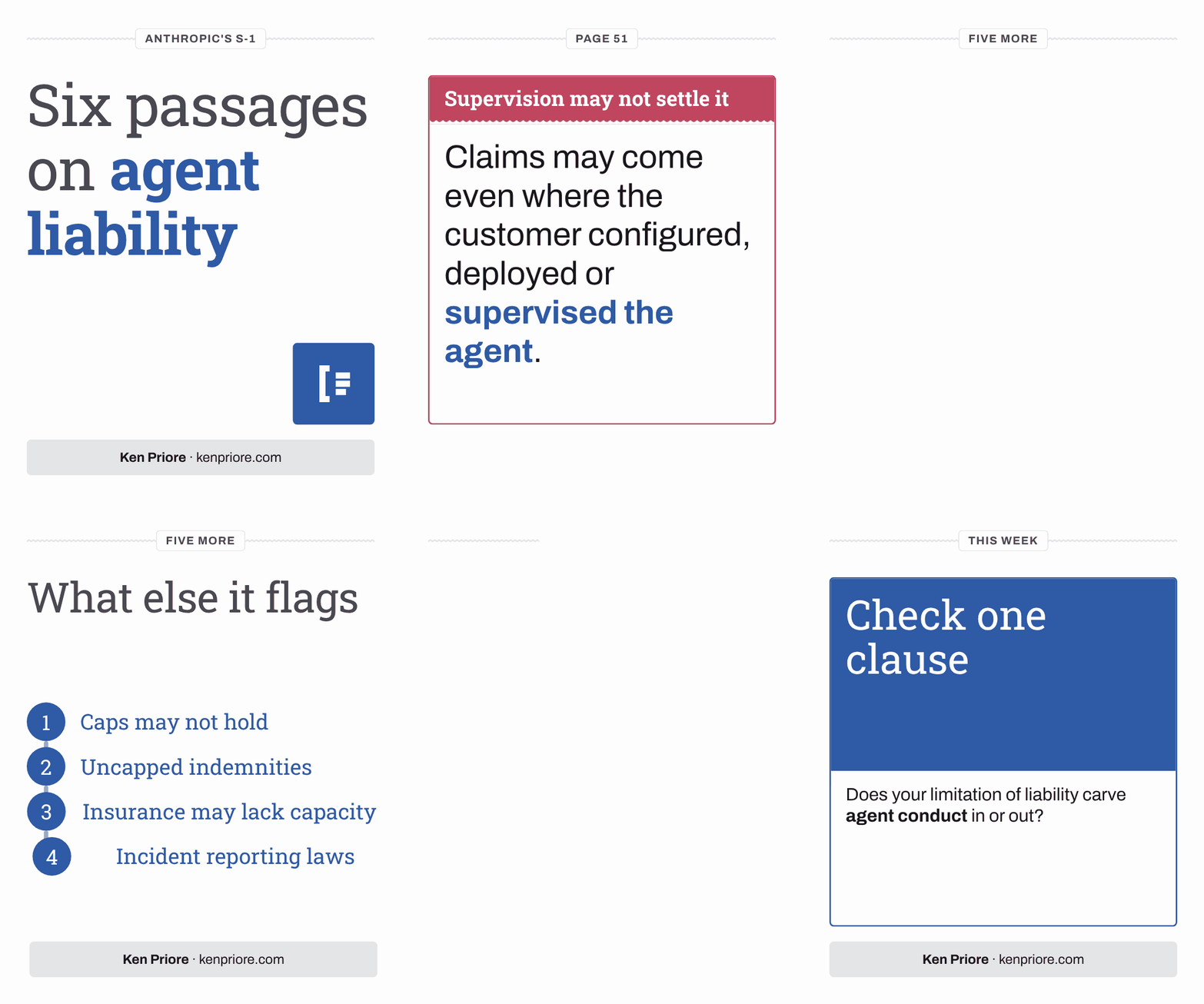
Anthropic's S-1, filed October 26, spends two pages on what happens when one of its AI agents causes harm. The answer it gives investors is that nobody knows yet. Pages 50 and 51 of the filing say agency, product liability and professional negligence were built around human decisions and have not been authoritatively applied to autonomous AI. That's a vendor describing its own product in a document it can be sued over.
The animation that goes with this post pulls six passages from the filing. They read differently once you picture a customer on the other end.
Say Halvorsen Freight, a mid-size logistics company, gives an agent built on Claude access to its accounts payable system. The agent is told to clear a backlog of approved invoices. It pays one invoice twice. It pays another to a vendor whose bank details a phishing email swapped the week before. Halvorsen's controller reviewed the agent's setup and signed off on its permissions.
The controller's sign-off is the detail the filing speaks to most directly. Anthropic says it may face claims over harm caused by its agents' autonomous actions even where the customer configured, deployed or supervised the agent (p. 51). Supervision may not move the loss onto Halvorsen. It may not keep it off Anthropic either. Both sides will argue about it.
Halvorsen's contract with Anthropic has a limitation-of-liability clause. The filing says it's unclear whether those terms and its indemnities will be enforceable or adequate against claims arising from agent conduct (pp. 50–51). Some of its indemnities carry no cap at all. Certain agreements with external evaluators and testing vendors require Anthropic to defend and indemnify them against some third-party claims with no limit on its liability (p. 51).
Halvorsen's CFO will look to insurance next. Anthropic says no single insurer and possibly not the industry as a whole may have the capacity to cover a catastrophic AI-related incident (p. 51). Halvorsen's loss is nowhere near catastrophic. I'm less sure how a thin market at the top affects pricing for ordinary claims. A CFO renewing a policy should still ask the broker directly whether agent conduct is covered or carved out.
The regulatory passage names two statutes. New York's RAISE Act and California's Transparency in Frontier Artificial Intelligence Act require frontier developers to report safety incidents, and Anthropic flags exposure for reports that are late, incomplete or inaccurate (p. 91). Those duties sit with the developer. A customer running agents in production should know what its vendor reports, to whom, and whether the customer hears about it first.
The last passage sits outside the risk factors. In the business overview Anthropic says it is building applications purpose-built for specific professions and industry verticals (p. 9). Professional negligence is one of the three doctrines the filing calls untested against autonomous AI. An agent sold to accountants or lawyers raises the question of whose professional standard it will be measured against, the vendor's or the professional's who relied on it.
Anthropic tells investors these questions will be answered by courts and regulators across jurisdictions over time. Halvorsen doesn't have that long. Its general counsel can read pages 50 and 51 this week and then pull the company's own agent contracts: what the cap says, whether agent conduct is carved in or out, and who carries the loss when the customer approved the permissions. The vendor has told investors it doesn't know whether those clauses hold. Customers should negotiate as if they might not.