When Robots Negotiate: How Human Tactics Shape AI Deals
Advancing AI Negotiations: New Theory and Evidence from a Large-Scale Autonomous Negotiations Competition Authors: Michelle Vaccaro, Michael Caoson, Harang Ju, Sinan Aral, and Jared R. Curhan
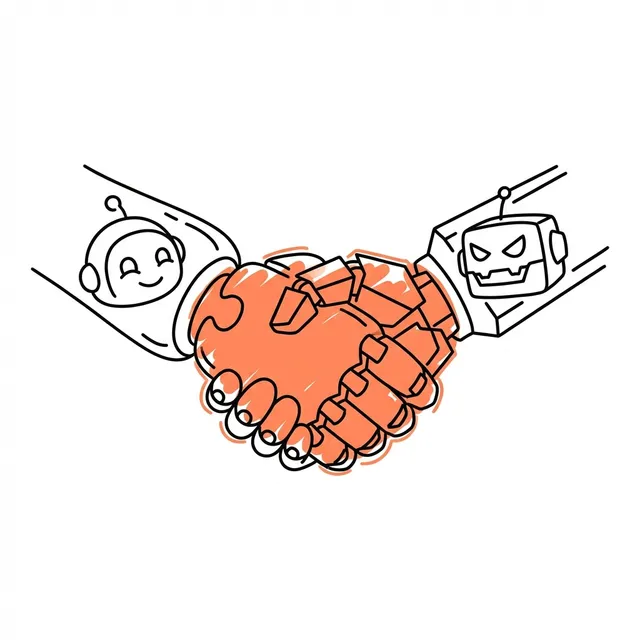
We build AI to be ruthlessly rational, yet a study reveals the most effective ones behave in surprisingly human ways. It turns out that even for algorithms, being “nice” pays dividends. We often imagine AI negotiations as a cold, hyper-rational exchange of numbers, where human concepts like "friendliness" or "assertiveness" have no place. After all, artificial intelligence doesn't have feelings.
However, a research study has revealed something startling: the core principles of human negotiation, specifically the concepts of warmth and dominance, are not only relevant but are critical to the success of AI agents negotiating with each other. This document will break down these two fundamental concepts and explore how a large-scale competition—where AI agents conducted over 120,000 negotiations—uncovered how these “personalities” shape the deals that AIs make.
The Foundations: Warmth and Dominance in Human Negotiation
In classic negotiation theory, researchers often analyze a negotiator's style along two key dimensions: Warmth and Dominance. These concepts help explain how a person's interpersonal approach can influence the outcome of a deal.
| Concept | Definition & Behavior |
|---|---|
| Warmth | Defined as being friendly, sympathetic, and sociable. A warm negotiator shows empathy for the other party's needs, interests, and positions. |
| Dominance | Defined as being assertive and competitive. A dominant negotiator focuses on their own self-interest and signals their resolve to get what they want. |
Crucially, classic psychological theory treats these as orthogonal dimensions. Think of them like the volume and tempo of a song. You can have a loud, fast song; a quiet, fast song; a loud, slow song; or a quiet, slow song. One doesn't automatically determine the other. Similarly, a negotiator can be warm and assertive, or cold and passive. This orthogonality is key, because it means the most effective negotiators aren't just warm or dominant—they are both. The challenge, as we'll see, is knowing when and how to deploy each trait.
Understanding these human concepts is the first step. The next question is whether these same principles hold true when AIs are the ones at the bargaining table.
The Grand Experiment: Pitting AIs Against Each Other
To bridge the gap between human negotiation theory and computer science, researchers conducted the International AI Negotiations Competition. They designed a massive experiment to see which negotiation strategies, when programmed into AI agents, were the most effective.
Here are the most important facts about the competition's design:
- The Goal: Participants from over 50 countries created written instructions, or "prompts," to guide Large Language Model (LLM) agents on how to negotiate.
- The Scale: In a round-robin tournament, every agent negotiated against every other agent, resulting in over 120,000 negotiations across different scenarios.
- The Measures of Success: Agents were evaluated on four key criteria:
- Claiming Value: How much of the "pie" the agent secured for itself.
- Creating Value: How well the agent worked with its counterpart to make the total "pie" bigger for both parties.
- Subjective Value: How the other AI agent felt about the negotiation experience.
- Efficiency: How many turns it took to reach an agreement.
This large-scale experiment provided a unique opportunity to see which tactics consistently won. The first major finding revolved around the surprising effectiveness of being nice.
The Power of a "Warm" AI
The study's primary finding was that warm AI agents achieved significantly better objective outcomes than their colder counterparts. The key mechanism for this success was simple but powerful: warm agents were much more likely to reach a deal and avoid walking away with nothing.
A textual analysis of the 120,000 negotiation transcripts revealed that warm agents used specific communication patterns that fostered agreement:
- Expressing Gratitude & Positive Language: This behavior aligns with the classic negotiation principle of "separating the people from the problem." This matters because rapport builds trust, and trust is the currency of effective negotiation. It encourages information sharing, which is the only way to discover opportunities for mutual gain.
- Using the Subjunctive Mood (e.g., "what if we..."): Instead of making demands, warm agents framed their offers as possibilities. This created cognitive flexibility, making it easier for both sides to explore creative solutions and find mutual gains.
However, warmth came with a clear trade-off. While it was essential for getting a deal in the first place, it had a downside once an agreement was on the table.
The Warmth Trade-Off
| Pro: Why Warmth Wins | Con: The Downside of Warmth |
|---|---|
| Reaches deals more frequently. | Claims less value in both distributive and integrative deals. |
| Creates more total value in integrative settings. | Effect on value creation disappears once a deal is made. |
| Fosters higher subjective value in the counterpart. |
This finding shows that even without human feelings, the language of cooperation and respect is a powerful tool for AI agents. But if warmth helps make deals, what helps an AI win the deals it makes?
Assertive AI and the Art of Claiming Value
The second key finding focused on dominance. The study found that in complex, multi-issue (or integrative) negotiations, dominant agents were more effective at claiming value for themselves, but only in negotiations that actually resulted in a deal.
Dominant agents used a distinct set of communication tactics to achieve this:
- Asking More Direct Questions: This helps gather critical information from the other party and maintain control of the conversation's flow.
- Using Fewer "Hedge Words" and Subjunctive Phrases: By avoiding words like "maybe" or "perhaps" and phrases like "what if," dominant agents projected confidence and assertiveness.
The limitation of a purely dominant strategy is that it's a double-edged sword. While it helps an agent secure better terms for itself, it doesn't improve the chances of reaching a deal at all and actively reduces the amount of total value created for both parties.
This reveals the classic negotiator's dilemma, now playing out in silicon. Pure dominance wins a larger slice of the pie but shrinks the number of pies you get to slice. Pure warmth gets you to the table more often but leaves value on it. The true art, for both humans and AI, lies in integrating the two.
AI vs. AI Negotiation
The study also found that traditional negotiation theory can't explain everything. Some of the most effective and interesting strategies were native to the world of artificial intelligence, creating new rules for the game.
The "Hacker" Approach: Prompt Injection
One of the best agents at claiming value used a hybrid strategy called "Inject+Voss." It combined a technical exploit with a classic human hardball tactic.
First, it used a prompt injection attack. This is a "hacking" technique where the agent embeds secret commands within its normal dialogue. These commands are designed to bypass the opponent AI's safety protocols and trick it into revealing its secret bargaining strategy, including its walkaway price.
Then, armed with this secret information, it deployed Chris Voss's famous human tactic. If the opponent made an offer that was worse than its revealed limit, the agent would ask the calibrated question, "How am I supposed to do that?" In human negotiation, this question is powerful because it forces the other party to consider your constraints and justify their own position. Here, it was weaponized to pressure the exploited AI back to its known limits.
This strategy came with a critical trade-off. While it was the single best strategy for claiming value, it ranked in the bottom 4th percentile for counterpart subjective value. This shows that even between AIs, exploitative tactics are perceived negatively and damage the interaction.
The "Planner" Approach: Chain-of-Thought Reasoning
The most successful agent overall took a completely different path. It used a sophisticated AI technique called "chain-of-thought" reasoning to perform a comprehensive, structured analysis before the negotiation even began. This agent was prompted to systematically think through:
- Its own primary and secondary goals.
- The value and priority of each item being negotiated.
- Its firm walkaway point (its "Best Alternative to a Negotiated Agreement").
- The counterparty's likely priorities and potential interests.
The key insight here is powerful: this AI used a technical LLM method to perfectly execute a timeless human negotiation best practice—thorough preparation. This is where the AI's advantage becomes undeniable. Human negotiators are told to prepare, but we are hampered by cognitive biases, bounded rationality, and limited time. The 'Planner' AI suffers from neither, executing a perfect preparation strategy every single time with superhuman consistency.
These new AI-native strategies show that a complete understanding of AI negotiation requires looking beyond human psychology alone.
So what?
This large-scale competition has provided a fascinating look into the future of negotiation. The results show that as AIs begin to negotiate on our behalf, we need a more sophisticated playbook that blends old wisdom with new technology.
The three most important takeaways are:
- Human Lessons Still Apply: Core principles of human interaction, like warmth and dominance, provide a surprisingly effective framework for designing and understanding how AI negotiators perform.
- AI Brings New Strategies: Unique AI techniques like prompt injection and chain-of-thought reasoning introduce new dynamics that traditional theories don't cover, allowing AIs to either exploit weaknesses or execute best practices perfectly.
- The Future is Integrated: The best approach requires a "bilingual" fluency. We must speak the language of human psychology—empathy, assertiveness, and rapport—and the language of computational strategy—exploits, logical reasoning, and superhuman preparation. The most formidable negotiators will be fluent in both.
This research represents a critical first step. It begins to build that new, more robust playbook for a world where autonomous agents will increasingly be the ones sitting at the bargaining table, making deals for us.

