Speed is underwritten by architecture
The ability to move fast is a function of what you've built underneath the speed. Governance architecture.

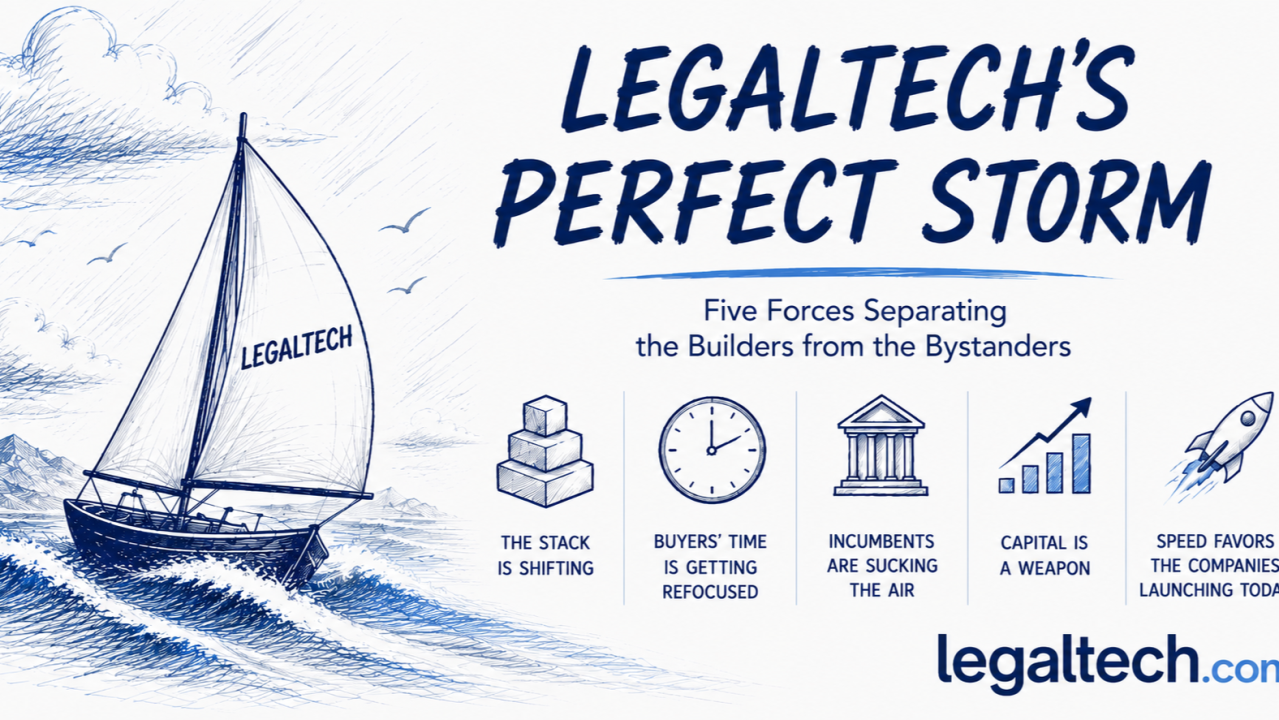
TLTF is right that the legal tech stack is restructuring underneath every team that thought they had a roadmap. Incumbents are credibly demoing capability they didn't have eighteen months ago. Capital is concentrating at the top. The youngest companies move at speeds the rest of the field can't match. His prescription — move faster, react immediately, ship weekly — is correct. I want to take it one layer deeper.
The ability to move fast is a function of what you've built underneath the speed. Governance architecture, the boring bit that lets you ship without accumulating liability you haven't priced, and is what separates teams whose velocity compounds from teams whose velocity catches up with them. The teams that will move fastest over the next three years are the ones building that architecture now. The ones that skip it will discover that speed without a substrate doesn't compound. It collapses.
The accountability gap has an architecture solution
Fiduciary duties — loyalty, care, the duty to act in the principal's interest — don't disappear when an action is automated. If a system owes a duty to a principal, and an agent acts in the principal's name, the duty has to attach somewhere. It doesn't vaporize because the principal wasn't in the loop.
The technical question is whether anything in the current stack gives that duty a place to land.
The standard answer is observability. Spans, traces, metrics, the OpenTelemetry stack — all built to answer "did the system perform as expected." The audit question in an agentic system is different. It's not "which tool did the agent call in what order." It's "was this action within the human's authorized scope, and can it be proved."
Six primitives separate those two questions:
- Identity and authority — which human authorized this, with what scope
- Intent capture — what the human was actually committing to
- Action record — what was done, when, by which agent, against which data
- Boundary log — what crossed which trust boundaries, between which systems and actors
- Outcome attestation — what changed in the world and whether it was within scope
- Custody chain with a verification surface — who held the data and action, where, and how any of it is provable
None of these exist in a standard logging stack. All of them are required by the fiduciary frame. When they're present, the audit is generated as a byproduct of the action itself, not reconstructed after something goes wrong. That changes the cost curve entirely. The audit stops being a tax on speed and becomes a feature of it.
AI adoption isn't lagging because the models aren't capable enough. It's lagging because we lack assurances on how a system got to an outcome, and whether it can be trusted at speed and scale. Observability primitives make that proof a property of the system rather than something you reconstruct after the fact.
Cognitive offloading
Observability answers what happened. It doesn't solve the human bottleneck. Reacting immediately puts real pressure on the humans in the governance loop, and compliance built in at the design stage costs less cognitive effort than compliance added after the fact.
Teams that try to govern agents by reviewing every output run a process that breaks under speed and volume. Build decision architecture into the system, review the exceptions, and the system gets less fragile over time as it learns from real-world outcomes.
Legal thinking has the most value upstream ,structuring institutional knowledge, encoding decision rights, building conflict resolution logic into agent parameters before the agent acts.
The architecture has three layers.
Routine cognitive load, extraction, classification, summarization, format normalization, moves to cheaper specialized models tuned for that work. Call it the operator layer. Token spend gets allocated the way firms allocate billable hours: the commodity work goes to the lowest-cost resource that can handle it reliably.
Contextual judgment is a different problem. Does this clause fit our policy? Does this interaction trigger a notification? Does this matter need escalation? That goes to a system holding policy context, surfacing decisions only when the answer is non-obvious. Human attention goes to the ambiguous case, not the routine one.
High-stakes commitments, the actions that create enforceable obligations,stay human. Surrounded by the attestation record from the observability layer. Authorization, scope, and outcome captured at the moment of commitment. This is where the fiduciary duty attaches, and where human judgment is genuinely irreplaceable.
When all three layers are working, teams can sustain the pace the market demands. Most of the surface area is already handled. Human attention goes to the decisions that need a human. The governance architecture produces speed rather than constraining it.
So move fast and govern things…
This is the best time to be building in legaltech.
The companies that come through this period won't be the ones that moved fastest in absolute terms. They'll be the ones whose speed was underwritten by architecture: observability that generates the audit as a byproduct of every action. Cognitive offloading that reserves human attention for commitments that matter. A fiduciary frame held in front of every product decision, because the duty doesn't go away when the agent does the work.
TLTF is right. Move fast. But you can only move as fast as your architecture lets you. Build that, and the speed takes care of itself.
 Zach Posner