Self-improving agents are an attractive idea
The governance implications are uncomfortable
Self-improving agents are an attractive idea. An agent watches its own performance, identifies failure patterns, adjusts its approach, gets better over time. Researchers in the hyperagents line of work are pushing this further: adding a metacognitive layer that lets the system reason about its own reasoning and rewrite parts of its own playbook.
The governance implications are uncomfortable.
Compliance reviews assume the system you reviewed is the system running in production. Pre-deployment testing, model cards, risk classifications: they all rest on that assumption. A self-improving agent breaks it. The version that passed review on Monday is not the version handling customer interactions on Friday. Behavior has shifted, and the shift wasn't approved by anyone.
That creates a question regulators will start asking: how do you know the agent is still operating within its authorized scope? The eval suite was run once. The risk assessment was done at design time. The model behaved one way during testing and another way after a week of self-adjustment, and nothing in the operational stack catches the delta.
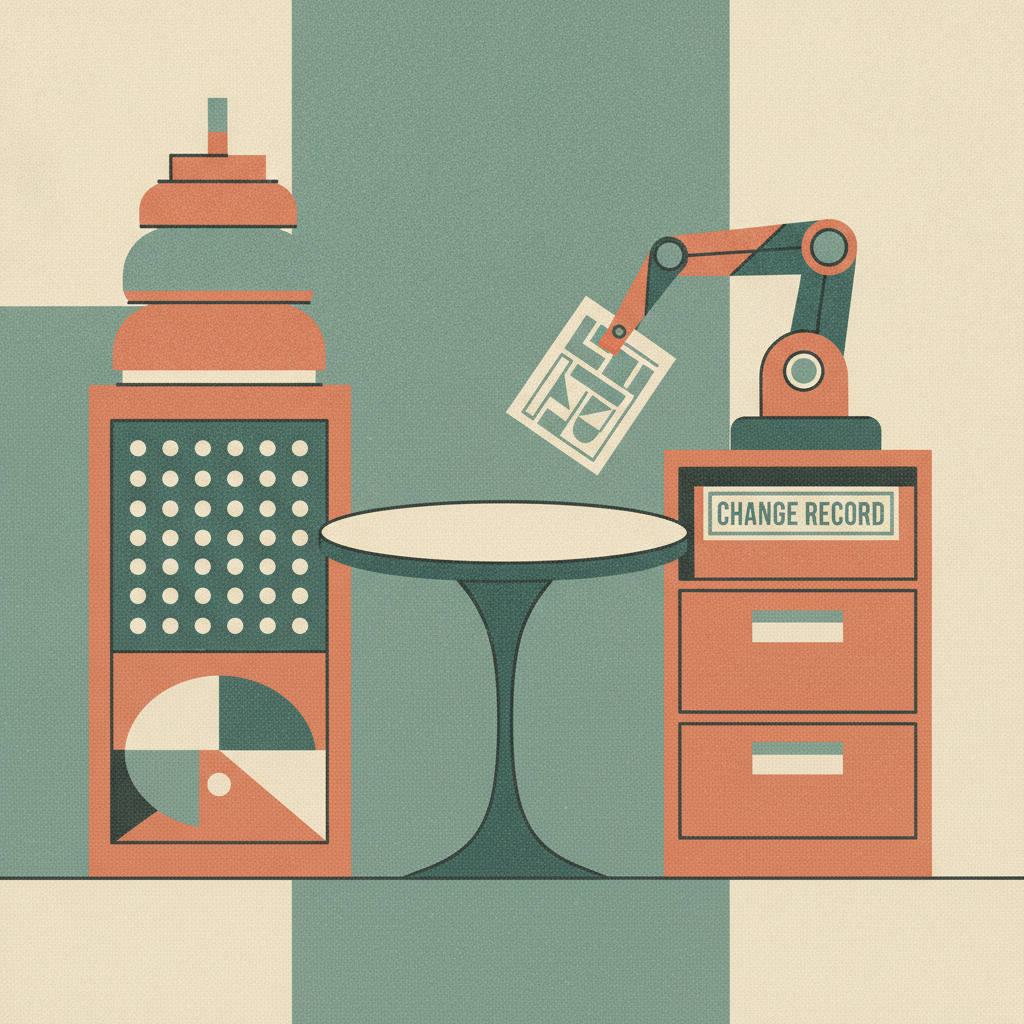
Product counsel has a useful intervention here. Self-improvement should be treated like a software release. Each material modification (prompt rewrite, tool addition, weight adjustment) needs a change record, an impact assessment, and a rollback path. If the agent rewrites its own approach, the rewrite is the artifact under review.
Treating modification this way makes self-improvement deployable in regulated environments. The agents that will succeed in the enterprise are the ones that ship with a control plane for their own evolution. The others will drift out of scope, until something visible breaks.