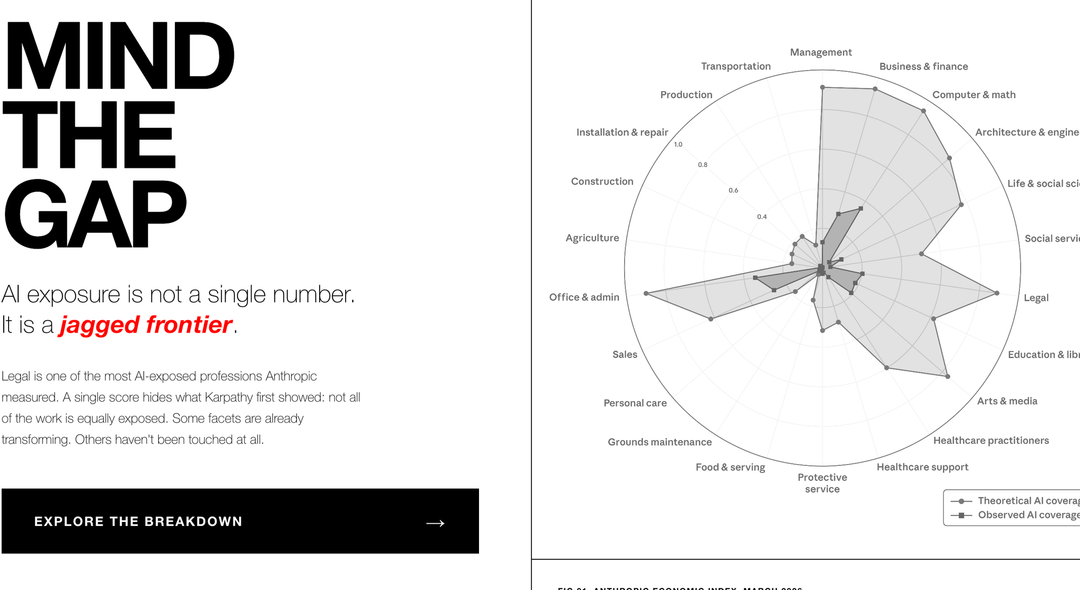
In May I published a piece anchored on one reading from Anthropic's Economic Index. Legal work scored around 7 out of 10 on AI capability while adoption sat far below it.
Anthropic has published three Economic Index reports this year. None of them carries an occupation-level capability score for legal work. The January report replaced that framing with five economic primitives. The measure I built on was withdrawn.
The gap it described is still open, in a different place.
Adoption caught up. The Association of Corporate Counsel puts in-house use at 52 percent, up from 23 percent in a year. Thomson Reuters has 74 percent using AI several times a week. By my own May argument, that should have closed things.
It did not.
Thomson Reuters surveyed 1,816 people across 62 countries in June, and 91 percent say their organization falls short of what the technology could deliver. The ACC found the same shape separately: 81 percent of chief legal officers assert value while the metrics to prove it are missing.
Another number came in July, from a vendor-run survey of 207 personal injury attorneys. Seventy-eight percent have engaged with AI and 30 percent regularly embed it in practice. Ninety-nine percent will not use output they cannot verify.
So is trust the source of this gap?
The pattern runs wider than legal. St. Louis Fed economists scanned roughly 490,000 earnings call transcripts from 5,198 US public companies and found that about 95 percent of statements about AI productivity describe expected future gains rather than realized ones. That share has held steady since 2023. Legal is not lagging the economy here. It is showing the same thing at closer range.
The interactive is still at mindthegap.kenpriore.ai. The ten task dimensions and five work modes hold up as a way to sort your own department's work, and I would now use them to ask a narrower question than I did in May: which of these could you account for if someone asked?