Harvey's Product Strategy
"The in-house teams are like about a year behind I’d say... most of them now are interested in like piloting the tools and checking them out, but change management across a lot of in-house teams [hasn't] happened." — Winston Weinberg, Co-Founder & CEO, Harvey
I spent this weekend breaking down Winston Weinberg's podcast and building an intelligence deck on Harvey's product strategy (links below). Most coverage focuses on growth metrics - 550 employees, massive funding, AmLaw 100 adoption. That misses the architecture.
Harvey isn't building better chatbots. They're building the scaffolding that makes autonomous agents possible.
Harvey runs on OpenAI, Anthropic, and Gemini simultaneously - not vendor lock-in, but model agnosticism that optimizes for different legal tasks. They committed 6 months to building security infrastructure over UI features. That delay was the strategy. The wrapper risk is real: any UI-only feature gets absorbed by the next model update.
Consumer AI (ChatGPT, Claude) optimizes for chat interactions. Documents are temporary uploads that disappear after the conversation. Legal work is document-centric - contracts, briefs, discovery materials are the workflow, not a feature. Harvey treats documents as persistent artifacts that feed an institutional knowledge base.
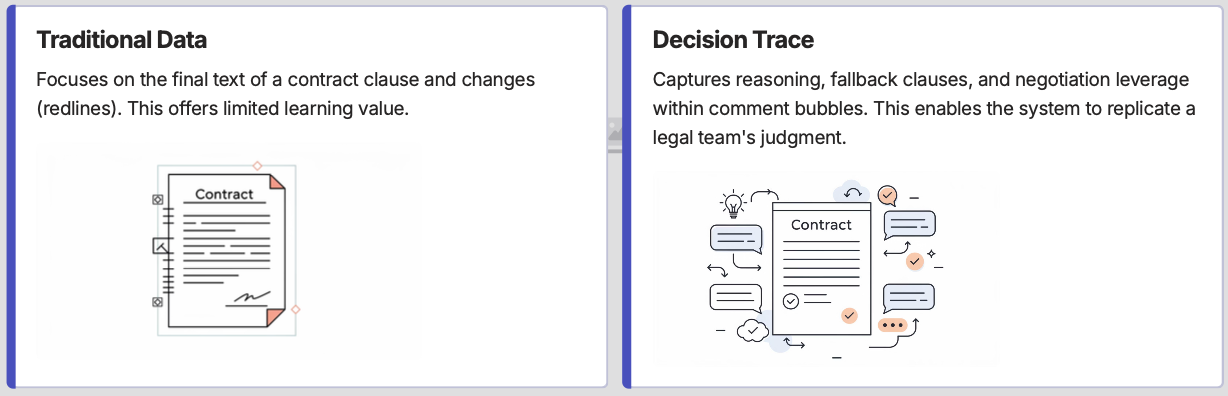
Generic models capture track changes - what you edited. Harvey intends to capture decision traces - why you changed "all" to "direct" in the indemnification clause, what compliance requirement drove it, and what fallback position you negotiated. That reasoning is the legal knowledge worth training on. The contract text is just the output.
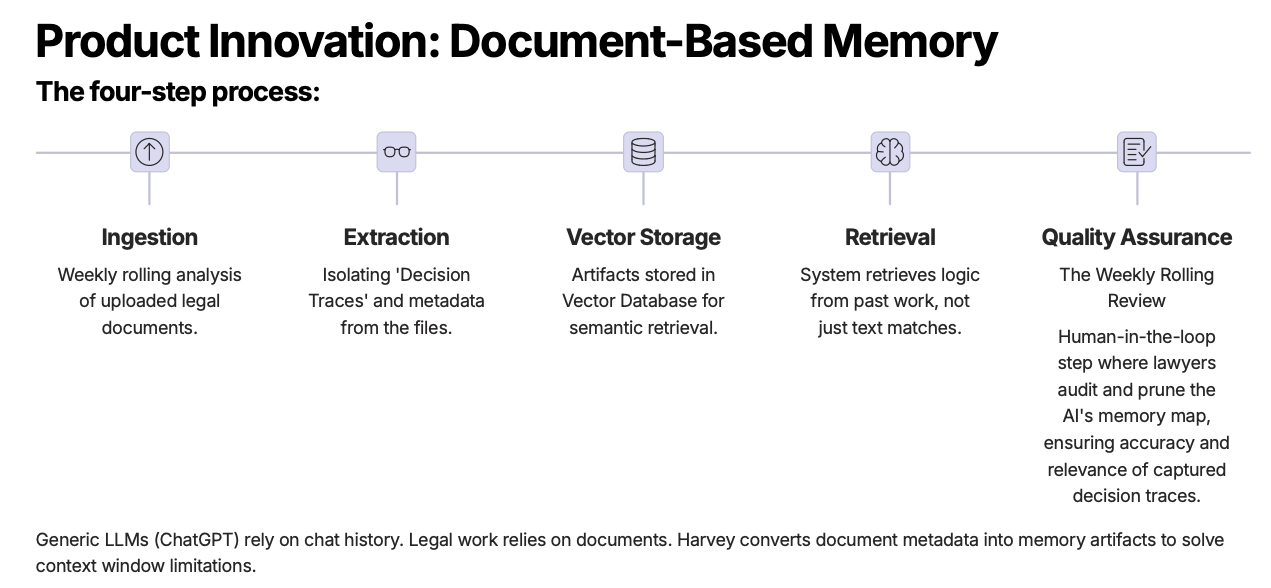
The 2026 roadmap prioritizes infrastructure over UI speed. Ethical walls that prevent data leakage between matters. Auditability for every AI action. Granular retention windows (30-day vs 6-year) customizable by matter type. You can't deploy agents that work autonomously for days without this foundation built first.
The go-to-market insight: in-house teams are roughly a year behind law firms in adoption. That's not a threat - it's the new partnership model. Law firms are becoming the AI activation channel for clients. Shared Spaces creates the workspace where firms teach in-house teams how to use these tools. Winston's observation: "The law firms actually teach them how to use Harvey."
Full Breakdown here:
Full Interview here:
#LegalTech #AIGovernance #ProductCounsel #LegalOperations #EnterpriseAI #TrustInfrastructure

