Governance protocols for AI systems when regulation lags deployment
With AI regulation lagging, forward-thinking organizations can bridge the gap through robust internal governance frameworks, ensuring ethical AI development while gaining competitive advantage
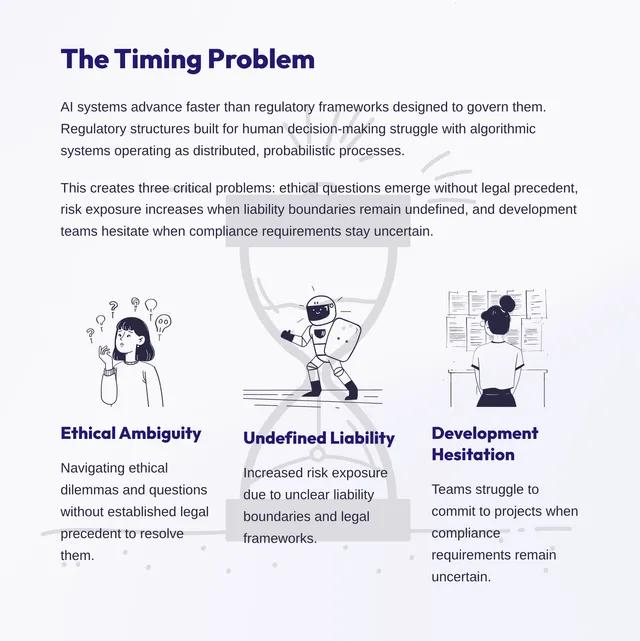
Organizations face a timing problem: AI systems advance faster than regulatory frameworks designed to govern them. This gap creates legal uncertainty for both developers and deployers, but it also creates an opening for organizations willing to establish internal governance protocols before external mandates arrive. Based on analysis examining the regulatory lag documented in Harvard Law School's "Is the law playing catch-up with AI?" article, this piece outlines the specific governance mechanisms that legal and product teams can implement now to manage AI-related risks, establish accountability, and maintain development velocity despite regulatory ambiguity.
The regulatory gap and its operational consequences
AI development currently outpaces legal infrastructure. Regulatory frameworks built around human decision-making struggle to address algorithmic systems that operate as distributed, probabilistic processes rather than discrete human choices. This creates three specific problems for organizations: ethical questions emerge without established legal precedent to resolve them, risk exposure increases when liability boundaries remain undefined, and development teams hesitate to commit resources when compliance requirements remain uncertain.
The technical complexity of AI systems compounds these challenges. Algorithmic decision-making often involves emergent behaviors and interactions that resist straightforward causal analysis. When outcomes depend on millions of weighted parameters trained on vast datasets, traditional legal concepts like intent and causation require reinterpretation. The expertise to understand these systems concentrates in private companies and research institutions, while legislative bodies work to develop technical fluency. This knowledge asymmetry slows regulatory development and increases the likelihood that eventual regulations will miss critical technical details.
Internal governance as regulatory gap mitigation
Organizations can address regulatory uncertainty by implementing governance frameworks that operate independently of external mandates. These frameworks establish internal standards for AI development and deployment, creating organizational accountability mechanisms before legal requirements formalize. The approach supplements rather than replaces future regulation, providing organizations with operational clarity while regulatory frameworks develop.
Effective governance protocols include six core components that address the specific challenges AI systems present. First, ethical guidelines define organizational principles for AI use, translating abstract values like fairness and transparency into specific development constraints. Second, risk management processes identify and assess AI-specific risks, including data quality failures, model degradation, and unintended behavioral patterns. Third, documentation standards establish records of AI system design, training data provenance, and deployment conditions. Fourth, accountability mechanisms assign responsibility for AI system outcomes across development and deployment teams. Fifth, stakeholder engagement incorporates perspectives from legal, technical, ethical, and user communities into AI governance decisions. Sixth, auditing regimes provide systematic assessment of AI systems against defined risk criteria.
These components function as an integrated system rather than independent protocols. Documentation standards enable auditing, which identifies risks that inform accountability assignments, which shape ethical guidelines that constrain development choices. The framework creates feedback loops that improve governance over time as organizations learn from AI system performance and stakeholder input.
Developer-specific governance protocols
Organizations developing AI models require governance protocols that address training data decisions, model architecture choices, and pre-deployment validation. These protocols intervene at the points where developer decisions most significantly affect downstream system behavior and risk exposure.
Data governance establishes the first control point. Protocols specify data provenance requirements, quality assurance processes, and prohibited data sources. Organizations document where training data originates, how it was collected, what preprocessing occurred, and whether collection methods complied with applicable privacy requirements. This documentation serves multiple purposes: it enables later auditing, supports due diligence when deploying models, and provides evidence of responsible development practices if disputes arise.
Transparency requirements shape model development decisions. While perfect explainability remains technically infeasible for many model architectures, developers can document model design choices, training procedures, and known limitations. Organizations establish internal standards for what constitutes adequate documentation, balancing technical feasibility against accountability needs. For high-stakes applications, these standards require more extensive transparency mechanisms, potentially including model cards that document intended use cases, known failure modes, and performance characteristics across different populations.
Safety engineering protocols establish testing regimes before deployment. Organizations define risk thresholds that trigger additional scrutiny, such as applications affecting legal status, financial standing, or physical safety. When models approach these thresholds, governance frameworks require adversarial testing, bias audits, and staged rollout protocols that monitor for unexpected behaviors. The protocols specify when models require human oversight and what deployment restrictions apply to different risk levels.
Technical safeguards protect against specific failure modes. Security assessments identify vulnerabilities in model inference systems, data pipelines, and access controls. For systems generating synthetic content, additional protocols verify output against known manipulation risks. Organizations establish red team processes that systematically probe for security weaknesses and maintain records of identified vulnerabilities and remediation steps.
Deployer-specific governance protocols
Organizations deploying AI models developed internally or by external providers face different governance challenges. Deployment decisions determine how models operate in production environments, what data they access, and what consequences follow from their outputs. Governance protocols for deployers focus on pre-deployment assessment, vendor due diligence, contractual risk allocation, and ongoing monitoring.
Risk assessment precedes deployment decisions. Organizations evaluate the specific context in which a model will operate, including what decisions the model will influence, what populations will encounter it, and what harms could result from errors. This assessment identifies model limitations that matter in the intended deployment context, even if those limitations seemed acceptable during development. The assessment produces a risk profile that informs deployment constraints, such as human-in-the-loop requirements, output restrictions, or prohibited use cases.
Due diligence requirements increase for externally developed models. Organizations cannot rely solely on vendor representations about model capabilities and limitations. Due diligence protocols require testing models against representative deployment scenarios, evaluating performance across relevant population segments, and documenting any discrepancies between vendor claims and observed behavior. Organizations maintain records of this testing to support later auditing and to establish that deployment decisions reflected informed risk assessment.
Contractual frameworks allocate responsibility between model developers and deployers. Standard procurement agreements often fail to address AI-specific risks, leaving ambiguous which party bears responsibility for model failures, bias-related harms, or data protection violations. Governance protocols establish baseline contractual requirements for AI procurements, specifying minimum documentation standards, performance guarantees, liability allocation, and procedures for addressing discovered flaws. Organizations avoid relying on vendor assurances without contractual backing.
Monitoring systems track deployed model performance. AI systems can degrade over time as training data becomes stale or as usage patterns shift beyond original design parameters. Monitoring protocols establish metrics that indicate degradation, thresholds that trigger review, and escalation procedures when performance falls below acceptable levels. Organizations maintain monitoring records that demonstrate ongoing oversight and create audit trails for any interventions.
Data provenance and model documentation requirements
For legal teams, governance protocols create documentation obligations that enable later auditing and support legal defensibility. Organizations establish standardized records for each AI system covering training data sources and characteristics, data collection and preprocessing methods, model architecture and training procedures, validation results and known limitations, intended use cases and deployment constraints, and monitoring procedures and performance metrics. These records serve as the evidentiary foundation if questions arise about system design, deployment decisions, or response to discovered issues. Legal teams work with technical staff to define what documentation level suffices for different system categories, balancing comprehensiveness against feasibility. The protocols specify retention periods, access controls, and update procedures as systems evolve.
Pre-deployment risk assessment and monitoring protocols
For product teams, governance protocols establish gates that prevent premature deployment while maintaining development velocity. Organizations define risk assessment procedures that evaluate systems against organizational risk criteria before production release. These assessments identify deployment constraints, required safeguards, and monitoring requirements that follow the system into production. Product teams work within these constraints to design rollout strategies that gather real-world performance data while limiting exposure. The protocols specify what metrics indicate acceptable performance, what thresholds trigger escalation, and what procedures govern decisions to modify or withdraw deployed systems. By establishing these procedures proactively, product teams gain clarity about what requirements they must meet, reducing the delays that arise when governance becomes reactive rather than anticipatory.
Building organizational capacity ahead of regulatory formalization
Internal governance frameworks address the regulatory gap by establishing organizational accountability mechanisms before external mandates require them. Organizations that implement these frameworks gain operational clarity that enables continued AI development despite regulatory uncertainty. The frameworks also position organizations advantageously when regulations do arrive, as established governance protocols often satisfy regulatory requirements with minimal modification.
The approach requires sustained organizational commitment. Governance frameworks function only when embedded in actual development and deployment decisions, not merely documented in policy. Organizations succeed by integrating governance into existing processes rather than creating parallel compliance structures that teams circumvent. Legal teams enable this integration by translating governance requirements into specific development and procurement protocols that technical and product teams can implement.
As regulatory frameworks develop, organizations adapt internal governance to align with emerging requirements. The foundation established through proactive governance makes this adaptation more efficient than reactive compliance, as organizations have already built the processes and documentation that regulations typically require. The gap between AI capability and regulatory infrastructure persists, but organizations need not wait for external mandates to establish responsible governance practices.
References
Analysis based on Harvard Law School article "Is the law playing catch-up with AI?" examining the regulatory lag in AI governance frameworks.