A Beginner's Guide to the A2A Protocol: How AI Agents Talk to Each Other
The A2A protocol is a standard for collaboration, authentication, and communication between independent AI agents.
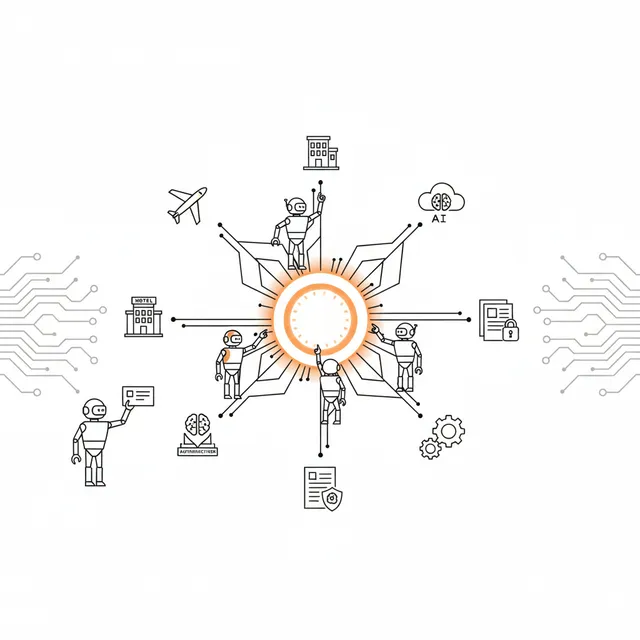
Your travel agent AI can book flights. Your hotel AI can find rooms. But getting them to work together? That requires custom integration for every connection—inefficient, hard to scale, and brittle when you need to swap in a better option.
The Agent-to-Agent (A2A) protocol solves this. It provides a standardized "common language" that allows different AI agents, built by different teams, to discover each other, securely connect, and collaborate. Here's what the A2A protocol is, who the key players are in any A2A conversation, and how the process works from start to finish.
What is the A2A Protocol?
The A2A protocol is a standard for collaboration, authentication, and communication between independent AI agents.
Initially introduced by Google in April 2025, A2A is now an open-source project housed by the Linux Foundation. Its primary value is that it removes the need for developers to write custom code to integrate different agents. By providing a universal channel for agents to work together, it paves the way for a more dynamic and powerful ecosystem of collaborative AI.
The Key Players: Understanding the Roles in an A2A Conversation
Every A2A interaction involves three distinct actors, each with a specific role and responsibility.
| Actor | Role |
|---|---|
| User | The human operator or automated service that initiates a request or sets a goal. |
| Client Agent (or A2A Client) | Acts on the user's behalf to initiate requests to other agents. |
| Remote Agent (or A2A Server) | The AI agent that receives requests from the Client Agent and performs the work. |
Note: A single AI agent can act as a Client Agent in one scenario and a Remote Agent in another, depending on whether it is initiating a request or receiving one.
Now that we know the players, let's walk through the step-by-step process of how they interact using the A2A protocol.
How It Works: A Three-Stage Process
The A2A protocol operates in three distinct stages, ensuring that agents can find, trust, and communicate with each other in a structured way.
Discovery
The first step is for the Client Agent to find a Remote Agent and understand its capabilities. This is achieved using an Agent Card.
An Agent Card is a JSON metadata document published on the Remote Agent's domain that acts like a digital business card. It contains three key pieces of information:
- Identity & Capabilities: What the agent is and a description of its available skills.
- Service Endpoint URL: The specific web address the Client Agent must use to communicate.
- Authentication Requirements: The security rules and schemes required to establish a connection.
Authentication
Once the Client Agent has the Agent Card, it authenticates itself with the Remote Agent using the specific security scheme detailed in the card. After the Client Agent is successfully authenticated, the Remote Agent takes over responsibility for authorization—granting the appropriate access control permissions for the requested task. This two-step process is a standard security practice, ensuring that an agent not only proves its identity (authentication) but is also granted only the specific permissions it needs to perform a task (authorization).
Communication
With discovery and authentication complete, the agents are ready to collaborate. The Client Agent sends a task to the Remote Agent using the JSON-RPC 2.0 format over a standard HTTPS connection. The Remote Agent processes the task and, if necessary, can request more information from the Client Agent before completing the work.
Once the task is finished, the Remote Agent sends a completion message back to the Client Agent, often along with a generated artifact. An artifact is the tangible output of a task, such as a document, an image, or structured data.
Handling Long-Running Tasks
For tasks that might take a long time to complete (e.g., those involving human interaction), the protocol has a special mechanism. If the Agent Card indicates support for streaming, agents can use Server-Sent Events (SSE). This allows the Remote Agent to send continuous status updates to the Client Agent over a single, open HTTP connection, keeping it informed of the progress. This structured, three-stage process provides a number of practical benefits for developers and users alike.
Why A2A Matters: The Core Benefits
The design of the A2A protocol provides several significant advantages for building collaborative AI systems.
- Standardization Having a common, agreed-upon method for discovery, authentication, and communication dramatically simplifies the process of integrating agents built by different teams or organizations.
- Privacy and IP Protection The protocol treats agents as "opaque agents," meaning they can collaborate without revealing their internal memory, proprietary logic, or specific tool implementations. This is crucial for preserving data privacy and protecting intellectual property.
- Easier Enterprise Adoption A2A is built on familiar and widely-used standards like HTTPS and JSON-RPC. Because organizations are already using these technologies, it lowers the barrier to adopting the protocol within existing enterprise systems.
What Needs Work
A2A is still early. Security models need refinement—authentication works, but authorization across organizational boundaries creates trust gaps. Governance remains unclear: who's liable when a client agent instructs a remote agent to take an action that causes harm? Performance tuning matters too—latency adds up when agents chain multiple calls.
A Common Language for the Future
A2A creates a universal channel for AI agents to communicate and collaborate. That matters because the alternative—custom integrations for every agent pairing—doesn't scale. The protocol is live now. Google, the Linux Foundation, and early adopters are building on it. If you're architecting AI systems that need to coordinate across organizational boundaries, this is the standard to watch.

